CPI drops hotter than expected. BTC sells off 3.8% in ninety seconds. Then — while every retail trader is deciding whether to short the breakdown — it reverses, rallies 5%, and takes out everyone who faded the spike.
The news was bad. The move was violent. And the reversal was visible in the order book twenty seconds before price confirmed it on the candle.
Most traders approach news one of two ways: they avoid it entirely, or they try to predict the direction and enter before the release. Both approaches miss the actual edge. The edge isn't in the news itself — it's in reading what the order book does with it.
Before the Release: The Book Gets Thin
The most consistently observable order flow pattern around scheduled news events happens before the number drops.
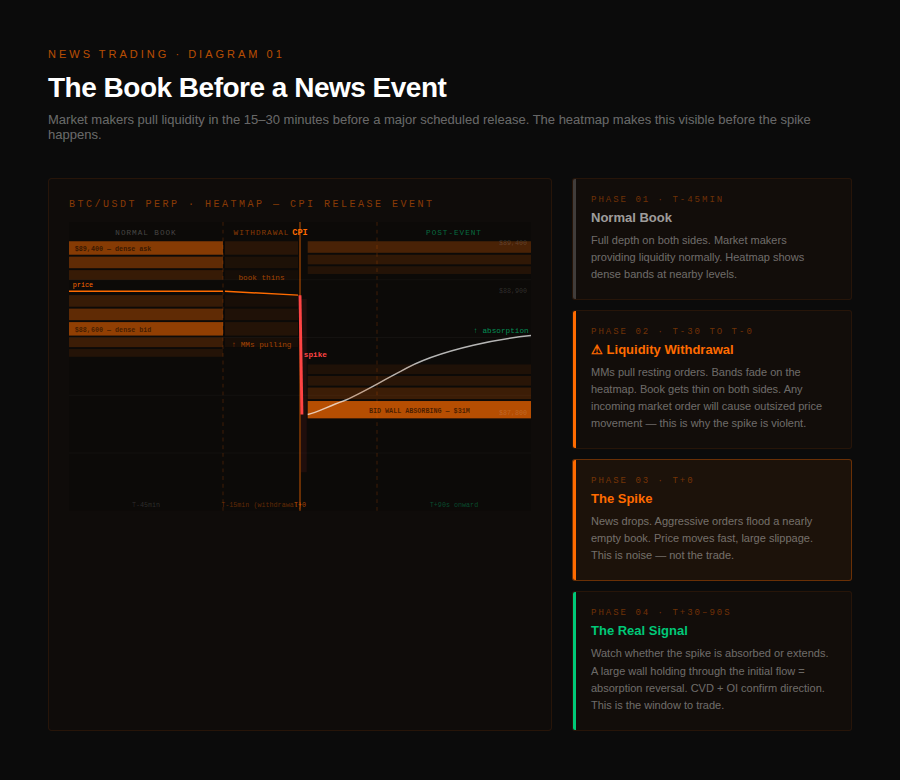
In the fifteen to thirty minutes leading up to a major release — CPI, FOMC decision, NFP — market makers and liquidity providers pull their orders from the book. They don't want to be on the wrong side of a large directional move with resting limit orders sitting exposed. The result is a visibly thinner book on the heatmap: bright bands that were sitting at nearby levels fade, the depth on both sides contracts, and spread widens.
This is a verifiable, repeatable pattern. It's also what creates the violent slippage that happens the instant the number drops — there's almost nothing in the book to absorb the incoming market orders. Price moves fast not because the news was extreme, but because there's nothing there to slow it.
Practical application: when you see the book pulling significantly at key levels before a known event time, that's your signal that a large move is coming regardless of direction. It's not a trade — it's a warning. Positions held through that window need to account for it.
Scheduled vs. Breaking: Two Different Animals
Not all news behaves the same way in the order book, and treating it as one category is a mistake.
- Scheduled releases — FOMC, CPI, NFP — are known in advance. The market has already partially priced the expected outcome by the time the number drops. What matters isn't the number in isolation, it's whether the number beats or misses expectations, and by how much. A CPI print that comes in at consensus often produces a sharp initial spike in one direction followed by a fast reversal — the "buy the rumor, sell the fact" dynamic. The spike is positioning unwinding. The real move comes after it.
- Breaking news — regulatory announcements, exchange hacks, large liquidation cascades, geopolitical events — has no priced-in expectation. The order book hasn't adjusted. Liquidity providers haven't pulled. When the news hits, the initial move is often the real move because there's no prior positioning to unwind. These events tend to produce more persistent directional flows.
The distinction matters for trade management. After a scheduled release, the first move is frequently noise. After genuine breaking news, the first move frequently has follow-through.
The First 90 Seconds: Knee-Jerk vs. Real Direction
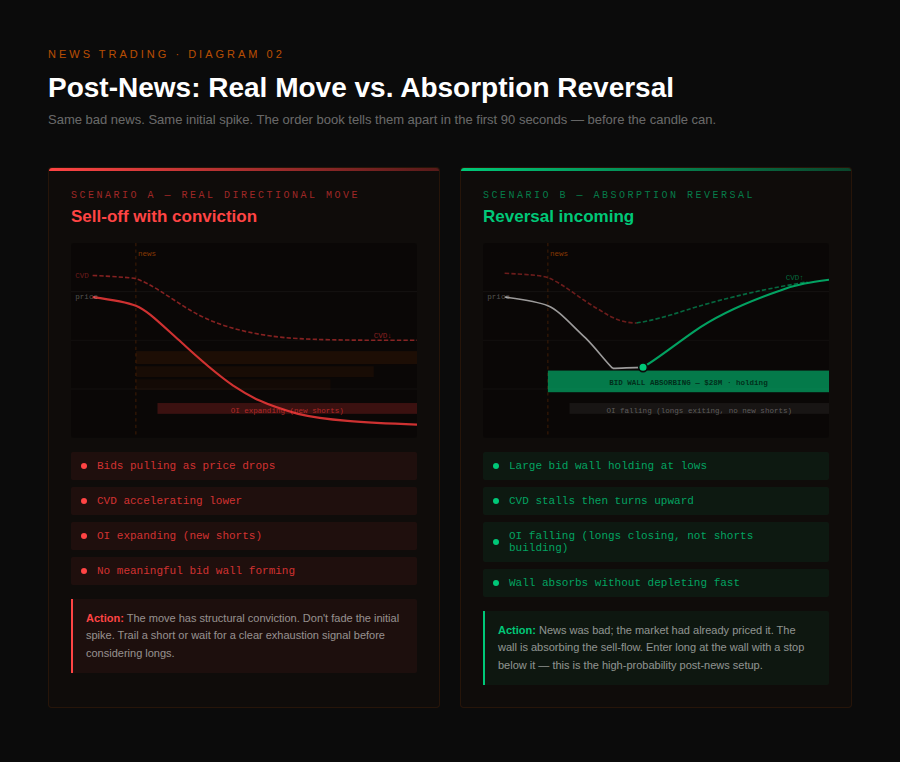
The most important window in any news trade is the sixty to ninety seconds after the release. This is where the order book reveals whether the initial move has conviction behind it — or whether it's about to reverse.
- Scenario A — the move has conviction. Bad CPI number. BTC sells off. In the order book: bids are pulling as price drops, no meaningful absorption visible, CVD accelerating in the direction of the move, open interest expanding (new shorts entering). This is a real directional move. The initial spike is the beginning, not a fade opportunity.
- Scenario B — absorption reversal. Same bad CPI number. Same initial sell-off. But in the order book: a significant bid wall is holding below current price, absorbing every unit of aggressive selling without depleting. CVD stops falling. Open interest isn't expanding — longs are just exiting, not new shorts entering. Price stalls. The news was bad; the order flow is telling you it's already priced. Reversal incoming.
The candle looks identical in both scenarios for the first thirty seconds. The order book doesn't.
"Buy the Rumor, Sell the Fact" — What It Looks Like in the Book
This is the most misunderstood news-trading concept among retail traders, and the heatmap makes it visible in a way nothing else can.
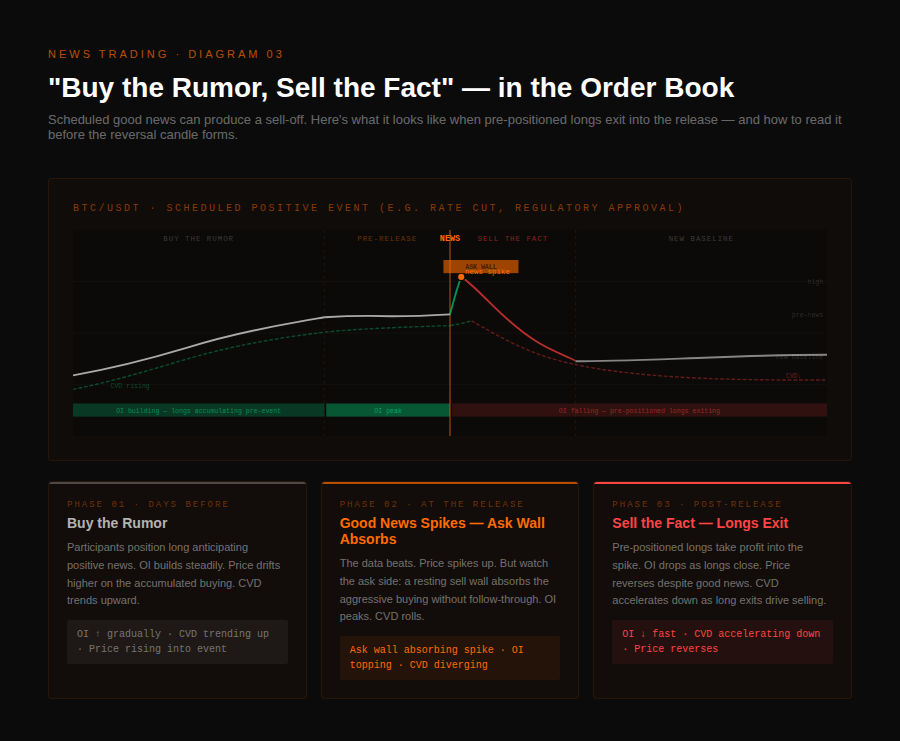
When a scheduled event is expected to be positive, participants position long before the release — buying the rumor. By the time the news drops, long positioning is elevated. Even if the number beats expectations, there's a reflexive wave of profit-taking from those longs. The result: price spikes up on good news, then reverses as longs exit into the strength.
What this looks like on the heatmap: immediately after a bullish print, you'll often see the ask side absorb aggressive buying without moving higher — resting sellers eating into the flow. CVD peaks and starts rolling. OI drops as longs close. The heatmap shows you the selling pressure before the candle forms a reversal bar.
The trade is not to chase the initial spike. It's to watch the order flow in the first minute and identify whether the move is extending with real conviction, or exhausting into a wall of sellers who were long before you.
What to Watch Before, During, and After
The framework is straightforward:
- Before: Monitor the book for liquidity withdrawal at key levels. A thinning book means a violent move is coming. Don't add exposure into it unless you're sized for the range.
- During (first 30 seconds): Don't trade. The initial spike is almost always noise on scheduled events. Let the first move happen without you.
- After (30–90 seconds): This is the window. Watch whether aggressive flow is being absorbed or breaking through. Watch CVD direction and whether it's accelerating or stalling. Watch OI — expanding OI means new participants committing to a direction; falling OI means existing positions unwinding.
The news tells you an event happened. The order book tells you what experienced participants decided to do about it — and that's the trade.
QuantFlows shows real-time heatmap, CVD, and open interest across Binance, Bybit, OKX, and Hyperliquid — giving you the order book layer to read news events before the candle confirms. Free during beta at quantflows.xyz.