BTC breaks above $87,000. Volume spikes. The chart looks clean — higher high, strong close, textbook breakout structure. You enter long. An hour later the candle reverses and you're stopped out for -1.8%.
Nothing broke on the chart. The setup was real. So what happened?
The move had no commitment behind it. Price ran up — but the traders who were short just bought back their positions and left. No new bulls entered. No fresh capital arrived. The chart showed you what happened. It had no way to tell you who was responsible for it.
That's the gap open interest fills.
What Open Interest Actually Measures
Most traders understand volume intuitively — more volume means more activity. Open interest is different, and the difference is everything.
Open interest is the total number of futures contracts that are currently live in the market. When a new buyer and a new seller create a contract together, OI goes up by one. When both sides close out, OI drops by one. When an existing position changes hands — one trader exits and another takes their place — OI stays exactly the same.
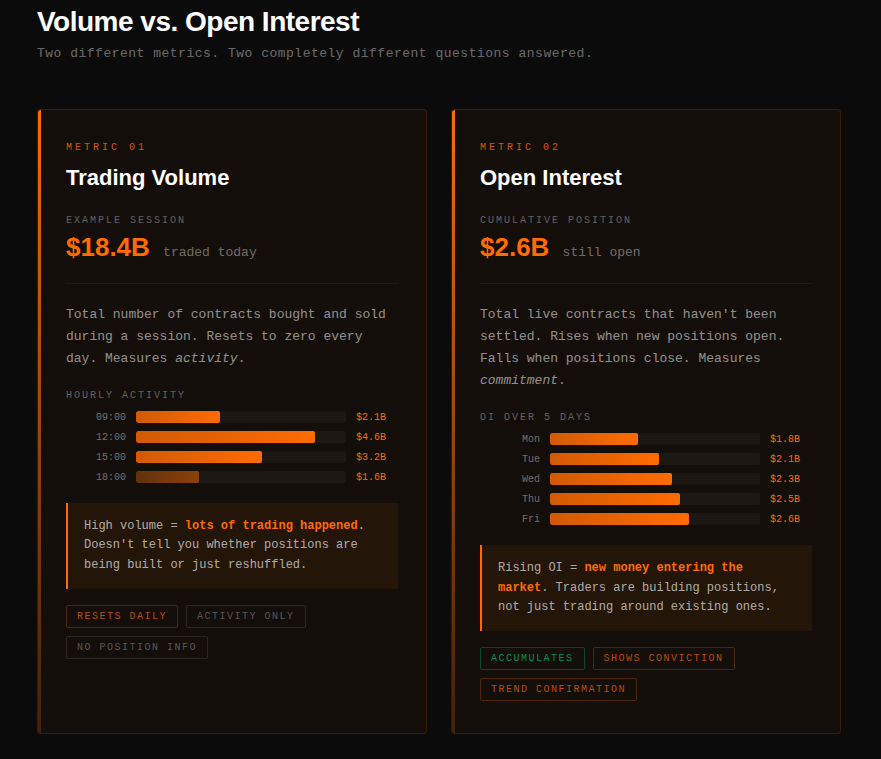
This is the mechanic that matters: open interest doesn't measure activity. It measures commitment.
In concrete terms: on a busy session, BTC perps across major exchanges might print $18B in volume and show $2.6B in open interest. That $18B includes every scalp, every hedge, every round trip made during the day. The $2.6B in OI is what's still on the table — positions that haven't been closed, capital that hasn't left the market.
When OI rises, new positions are being built. Longs and shorts are entering at current prices and choosing to stay. That's conviction entering the market. When OI falls, existing positions are being closed. People are pulling capital out. Whatever price is doing, the participation behind it is shrinking.
Why Volume Alone Will Mislead You
Here's a scenario most futures traders have lived through without knowing why it happened.
Price dumps hard. Volume is enormous — two or three times the daily average. You read it as sellers in control. But open interest drops 15% simultaneously. That's not sellers pressing — that's longs liquidating and shorts covering at the same time. Both sides are running for the exit. The massive volume signals chaos. The collapsing OI signals that both sides lost conviction, and the move is burning itself out.
Now change one variable. Same price drop, same candle structure, same volume. But this time OI increases by 12%. Completely different situation. New shorts are entering at these lower prices. Fresh capital is actively betting on further downside. This is a bearish move with structural support — and it's substantially more likely to extend.
Same price action. Same candle. Two entirely different market realities.
Volume tells you how much happened. Open interest tells you whether that activity built new positioning or just reshuffled old positioning that was already there.
The Four Market States
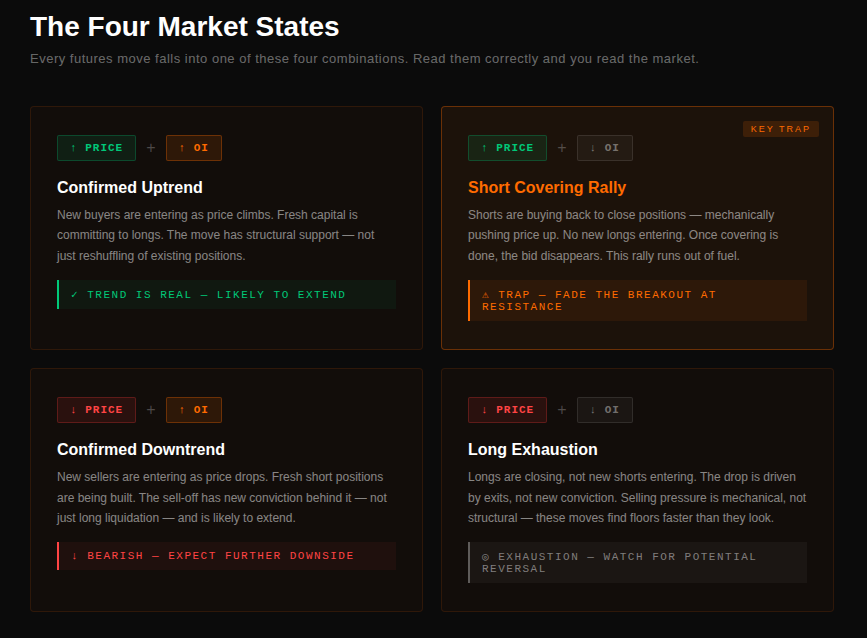
There's a matrix every serious futures trader should internalize. It comes from two variables — what price is doing, and what open interest is doing. The combinations produce four distinct states.
Rising price + rising OI is the cleanest read. New buyers are entering as price moves higher. The uptrend has fresh capital behind it. Trend confirmation — the move is structurally supported and likely to extend.
Rising price + falling OI is the one that traps traders. Price is going up, but open interest is declining. What's actually happening: shorts are covering — buying back contracts to close losing positions — which mechanically drives price higher. No new buyers are entering. Once the covering is complete, the buying stops. This rally runs out of fuel at resistance and reverses, often quickly and hard. This is exactly the setup from the opening scenario.
Falling price + rising OI is the bearish move with real momentum. New sellers are actively entering the market at current prices. They're not closing longs — they're building fresh short exposure. This kind of sell-off tends to extend because the pressure is structural. New supply is entering, not just old demand exiting.
Falling price + falling OI is exhaustion, not continuation. Price is dropping, but OI is also declining — meaning longs are closing rather than new shorts piling in. The selling is driven by people exiting, not by new conviction from the bear side. These drops find floors faster than they look like they will.
The Short Covering Trap in Crypto Specifically
Crypto futures are uniquely vulnerable to the rising price / falling OI setup because of how liquidation cascades behave.
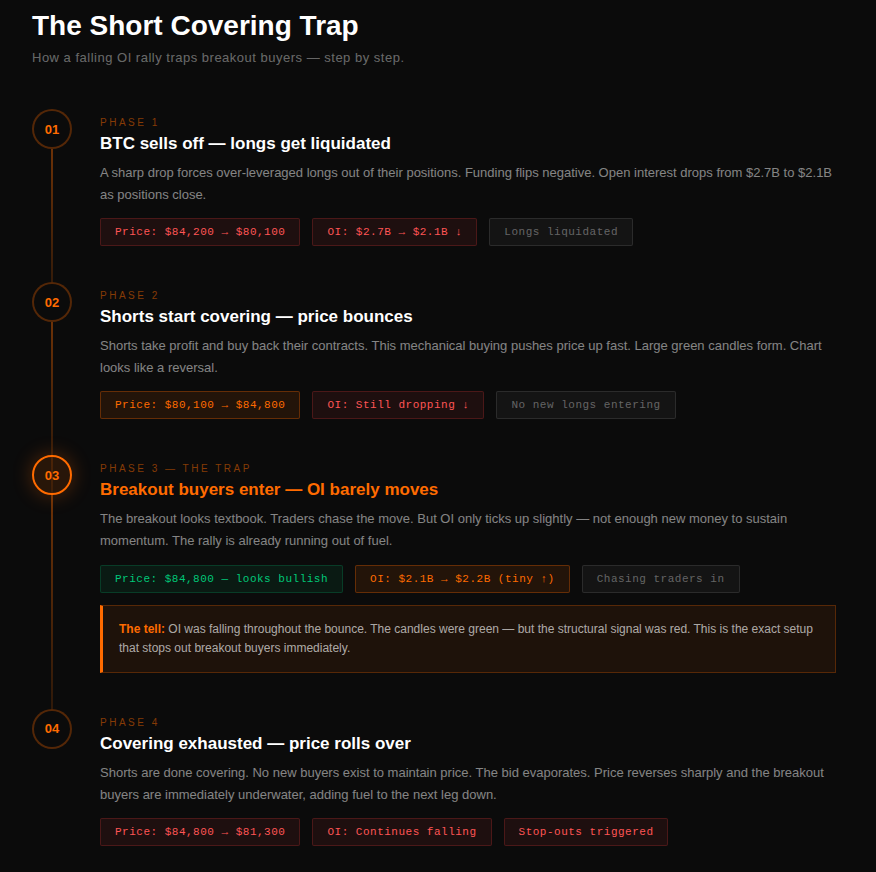
BTC sells off sharply. Long positions get liquidated — OI drops. Then the market snaps back. Short positions start getting squeezed. The covering pushes price up fast, generating large green candles that pattern-read as a reversal. Traders who chase the move enter long. OI ticks up slightly as these new longs arrive.
Then the squeeze exhausts. The shorts are covered. No new buyers show up to sustain it. Price rolls over and the longs who chased are immediately underwater.
The tell is always in OI during the initial phase of the run. If open interest was contracting while price was spiking, the rally was mechanical — driven by position closing, not by directional conviction. If OI was expanding during that same run, the move had genuine participants behind it and is worth respecting.
Experienced traders don't just ask "is price going up?" They ask: "who is responsible for this move — and are they still here?"
How to Apply This to Actual Trades
The mechanics sound technical. The application is direct.
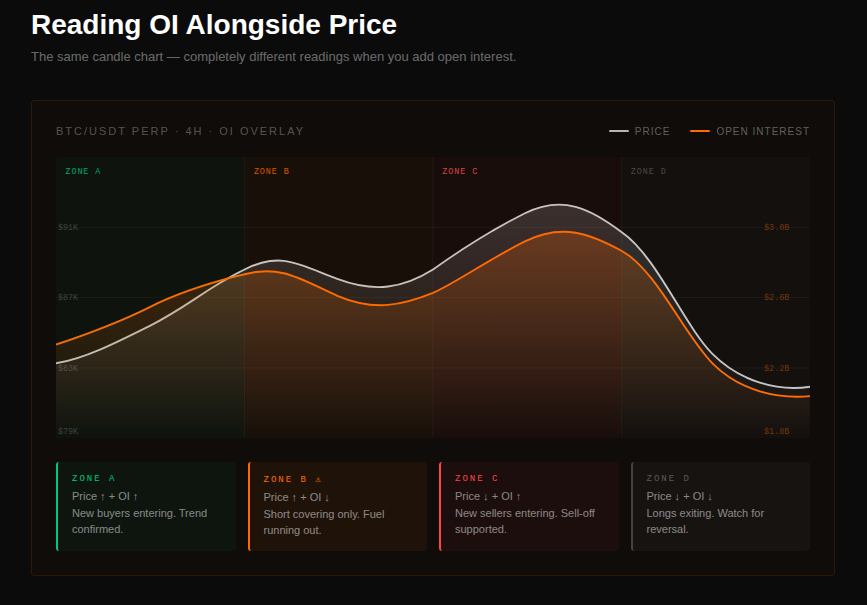
Before entering a breakout, verify whether OI is expanding alongside the move. A breakout where both OI and volume are rising is a breakout where new participants are committing capital in real time. That's higher quality than a breakout running on volume alone. BTC pushing through $90,000 while OI climbs from $2.1B to $2.4B across the session is a fundamentally different setup than BTC at $90,000 with OI sliding from $2.7B.
When a trend has been running for several days, use OI as an early warning system. A healthy trend shows OI holding steady or continuing to climb — new positions are being built as price extends. When OI starts dropping while price grinds higher, fuel is leaving the move. Positions are being closed, not added. The trend may grind a bit further, but structural support is weakening.
When a sharp move happens on collapsing OI, treat it with skepticism no matter what the chart looks like. High volume combined with falling OI is almost always a liquidation or squeeze event — not a new trend beginning. The instinct to chase that candle is exactly what the setup punishes.
The Dimension Most Traders Are Missing
Price and volume give you a two-dimensional view of the market. Open interest adds a third: positioning. It answers what price and volume cannot — not just what happened, but who made it happen, and whether they're still committed.
A candle can look bullish and be driven entirely by forced buying from trapped shorts. A sharp sell-off can look catastrophic and be mostly exhausted longs exiting with no new short pressure behind it. Open interest separates the signal from the structural noise.
The traders who consistently get caught on the wrong side of clean-looking setups are usually missing this layer. They're reading what the market showed — not what the market was actually doing underneath the candles.
Stop asking "where is price going?" Start asking "who's behind this move, and what happens when they're done?"
QuantFlows displays open interest changes in real time across Binance, Bybit, OKX, and Hyperliquid — alongside CVD, liquidation clusters, and live order book depth, all on one screen. Free during beta at quantflows.xyz.